Every time oil is extracted from the U.S. Strategic Petroleum Reserve, the more unstable the system likely becomes.
That’s because the man-made network of salt dome caverns, scattered along the Gulf Coast in Texas and Louisiana, was designed with an expected 25- to 30-year life span and intended only to be used during severe market disruptions.
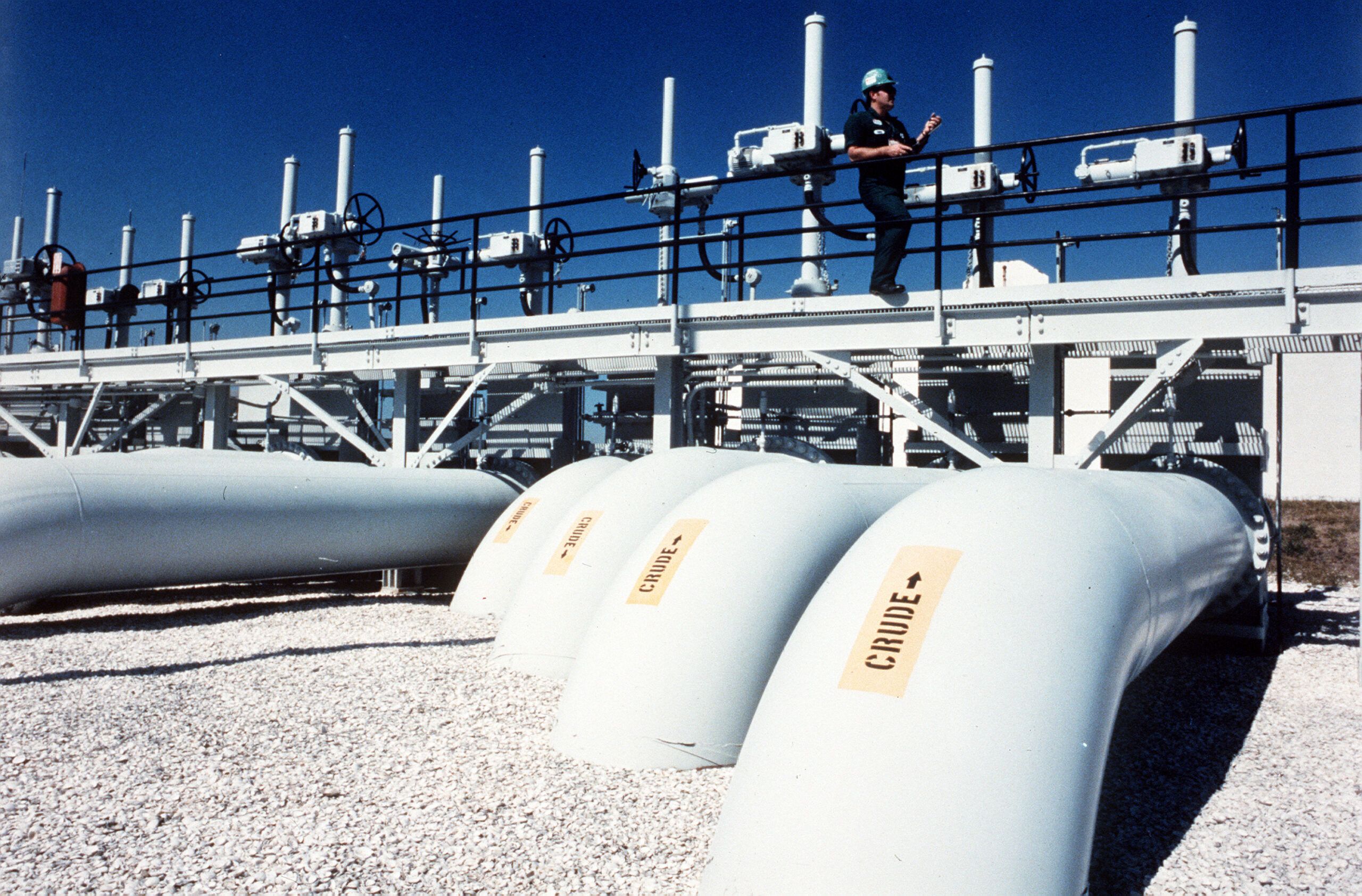
Inside the caverns
How exactly do the Strategic Petroleum Reserve caverns work?
Tulane Energy Institute Associate Director Eric Smith describes them as “big,
hollowed-out 50-story Coke bottles” that begin at 2,000 feet below the surface.“The caverns were created with a process using super-heated water to dissolve the salt, and they remain pressurized at all times with either natural gas or oil,” Smith says.
No matter how low the SPR reserves get, a protective cushion of oil always remains.
“When it’s empty it’s not really empty. There’s a cushion level of oil there to protect the intake pipe in each cavern.”
Now at 50-plus years old, the SPR has been used dozens of times, and as of August held only about 290 million barrels in total, which is near a record low.
As a result, industry insiders say, age and over-use are catching up to all four sites—Bayou Choctaw and West Hackberry in Louisiana and Big Hill and Bryan Mound in Texas.
After the U.S. government began storing crude oil there in 1977, inventories steadily grew to an all-time peak of over 726 million barrels in 2011, but the reserve was heavily tapped in 2022 following Russia’s invasion of Ukraine to help stabilize extreme market prices. In the wake of other major drawdowns, inventory levels have dropped significantly.
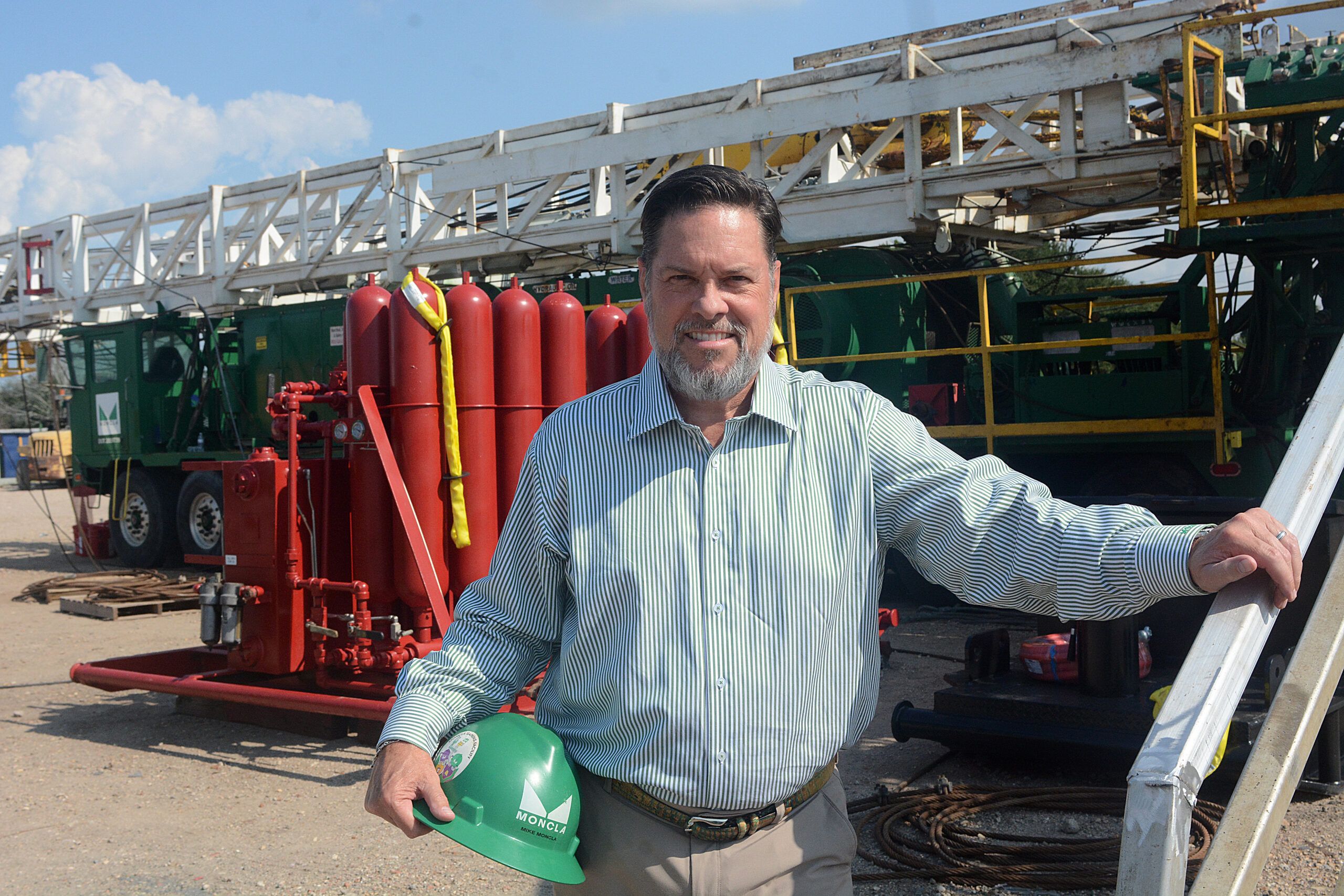
“There’s still a lot of oil, but it’s a lot less than it used to be,” says Louisiana Oil & Gas Association President Mike Moncla, whose Lafayette business—Moncla Workover & Drilling—has held a contract in the SPR for more than a decade. Recently, the company received a call for an “emergency selloff,” during which they worked 24 hours a day for eight days to offload 172 million barrels of oil into the market.
“Through the 11 years we’ve been there, we’ve had presidents fill it (the SPR) with high priced oil, sell oil off at low prices, not add oil when you’d think they should and sell oil when you’d think they shouldn’t,” Moncla says in a recent social media post. “Hopefully, President Trump keeps his word and fills the SPR after this conflict.”
President Gerald Ford authorized the creation of the SPR in 1975 as a national insurance policy, of sorts, not long after Arab members of OPEC cut off oil supplies to the U.S., causing oil prices to quadruple. The federal government subsequently chose massive underground salt domes for their location because salt and oil don’t mix, thereby providing a secure, low-cost containment method.
Oil for the SPR is acquired by the federal government through either an outright purchase or a swap transaction. During a swap, The Energy Policy and Conservation Act of 1975 gives the Energy Department the authority to exchange oil from the reserve with a private company. In return, the SPR receives more oil than it released; thereby acquiring additional oil.
“A swap could occur for a variety of reasons, such as when a refinery needs oils during an emergency to keep running,” Tulane Energy Institute Associate Director Eric Smith says. “In that case, whatever they take out must be put back into the SPR, with an additional amount as the fee.”
Not a market manipulator
The underlying problem is that the SPR is being used in a manner inconsistent with its purpose.
“Engineers designed the SPR caverns for strategic storage,” says Smith, who previously served on the board of DynMcDermott Petroleum Operations Co., the JV contractor responsible for managing the SPR from 1993 to 2014. “It was never intended to manipulate prices. That said, presidents and members of Congress have proved incapable of living under those restraints.”
Instead, they’ve repeatedly tapped into the SPR to improve gasoline prices during election years.
“The problem with that tactic is that it assumes that there’s an infinite supply of refining capacity to react to that extra crude … and it just isn’t there,” he adds. “In fact, it’s the opposite today. In many ways, our refining capacity has been reduced. As a result, we’re draining our strategic reserves with the intent of lowering gasoline prices, and it’s not happening.”
There’s also a very real danger that the caverns could de-stabilize over time due to over-use. Even though salt caverns are typically dependable locations for storage, “operators use fresh water in the process of removing the oil and if you use the same cavern over and over, eventually they could erode one cavern into the one next door,” Smith says.
While an SPR salt dome has never experienced a catastrophic structural collapse, there have been localized incidences of roof degradation, minor salt falls and surface sinkholes.
For now, the caverns are in “good shape for their age, and they haven’t been grossly undermaintained,” but the aging SPR has required billions of dollars in modern repairs and maintenance by the Department of Energy over the years.
Greg Upton, executive director of the LSU Center for Energy Studies in Baton Rouge, agrees that the SPR has value as a remedy for supply disruptions—such as the current conflict in Iran—“but in my view, using it to influence global prices is probably not going to be effective.”
While it makes sense from a business perspective to sell the oil in the reserve when prices are high and buy it when prices are low, there’s a concerning tradeoff, Upton notes: “What if there’s a major supply disruption and we don’t have the reserves that we need?”
In August, Trump said that oil from a recently struck deal with Venezuela would be used to replenish the SPR, but it’s unclear how quickly the Venezuela deal could provide oil for the reserve, as it will require significant investment and infrastructure work before production can rise substantially.
“There’s a lot of potential for Venezuelan crude (imports) to increase significantly, but that’s going to take several years to ramp up,” Upton says.
Ironically, when the federal government replenishes oil in the SPR, it often has a counterproductive effect, as it drives the prices higher due to the increased demand. “Prices need to be lower for that to happen,” Tulane’s Smith says, “but it also requires that the government appropriate money to buy the oil, which they are loathe to do.”
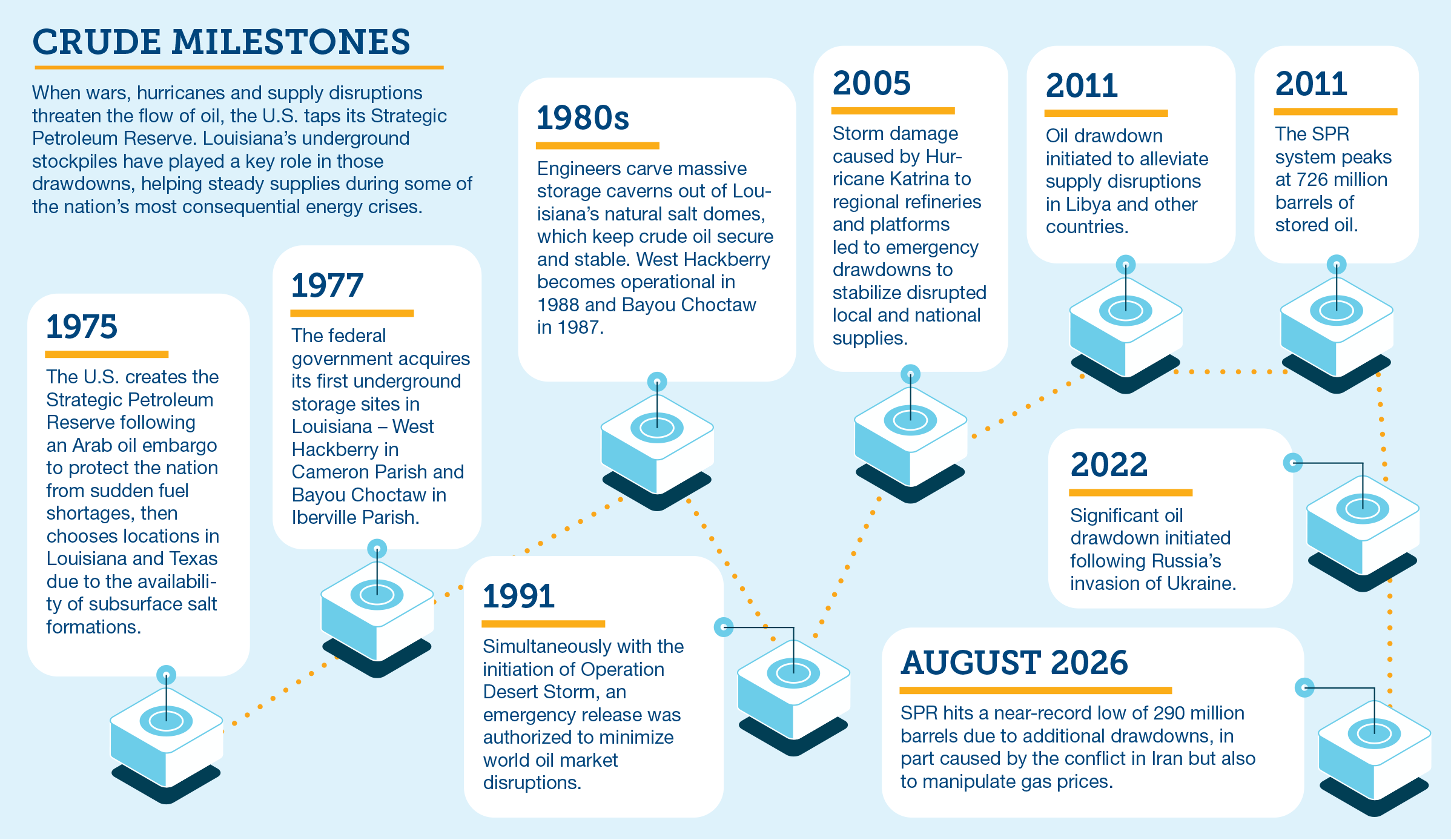
On the front lines
There’s little doubt that the SPR has been impactful to Louisiana over the years. The system is managed from the Strategic Petroleum Reserve Project Management Office in Elmwood, a suburb of New Orleans, and local contractors and suppliers have serviced the SPR since its creation.
LOGA’s Moncla has played a critical role there since the oil bust in 2015. That’s when his company took a long shot and bid on the Department of Energy contract for SPR’s workover rig services. Since the original contract was signed, their contract has been renewed twice—each time for three years with two consecutive one-year extensions.
As a workover contractor, Moncla only works on existing wells. Currently, there are 117 wells and 61 caverns across the four SPR sites, each with its own maintenance schedule to follow. The U.S. government operates a single rig and Moncla provides the labor.
“Most of our work is workovers, completions, remediations etc.,” he says. “We follow orders out there; it could be on an injection well or a withdrawal well, or we could be performing a cavern integrity test or pulling a casing to check its integrity. There’s always work to do out there, just to keep everything up and running.”