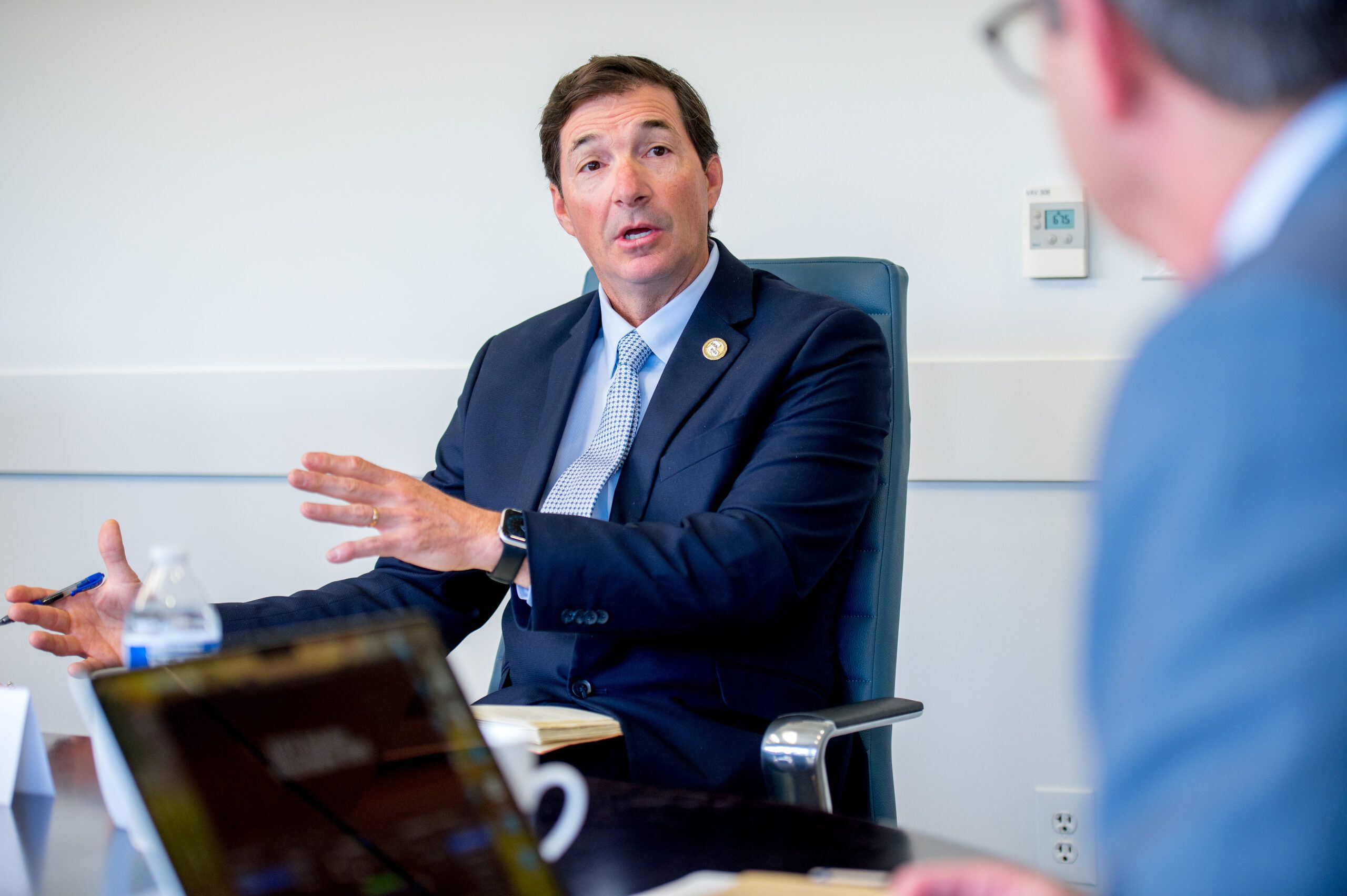
DAVID CRESSON
President and CEO, Louisiana Chemistry Association and Louisiana Chemistry Industrial Alliance
“I don’t think there’s anybody in business more advanced when it comes to these things than the industry that I work in. These are some of the biggest companies in the world, and it’s mind-blowing some of the things they’re working on. In health and safety alone, the advances in monitoring and observing what’s going on around facilities are absolutely stunning. These companies are going to use every available technology to ensure the safety of their people and the health of the communities. But there’s another angle—these technologies are creating new demand. One company told me one of their biggest emerging customers is data centers and AI. These facilities require massive amounts of cable, coatings, power and cooling, all of which rely on products from our industry. Drones are another example. Instead of sending a person into a dangerous area, you send a drone that can take even more accurate readings. It’s not about replacing jobs—it’s about supplementing them. And it’s not just digital. Technologies like carbon management, nuclear and hydrogen are going to reshape how we operate. We’re going to have to embrace these new technologies.”
 CONNIE FABRE
President and CEO, Greater Baton Rouge Industry Alliance
 CONNIE FABRE
“This is an exciting new area, and in our strategic planning meeting this past year, our board said we need to double down on helping companies share best practices with respect to implementing technologies. Some examples of things we’re seeing that companies are researching are things like how to use swarms of drones to go out and do inspections in the plant, identifying different things, and communicating with each other. We’re also seeing the use of gaming technology to develop digital twin models much more quickly. Additive manufacturing is another major development. It’s not just plastic parts anymore—they can print metal components that meet stringent requirements. Companies that used to keep parts in stock or source them globally can now just print them on demand. New technologies aren’t all digital either. Companies are using rope access instead of building scaffolding, which is a completely different way of thinking about work. And then there’s quantum computing. AI is just the tip of the iceberg. Quantum computing is already being used to solve major problems like logistics, and by 2029, it’s going to be out of the gate.”
MELODY LOCKWOOD
President and CEO, Livingston Economic Development Council
 President and CEO, Livingston Economic Development Council
“This can be one of the answers to the state’s workforce problem. Technology is not eliminating jobs, but creating more opportunities. The World Economic Forum forecast that AI will displace 92 million jobs but generate 170 million new ones by 2030. It’s really changing the skill sets that are required. Any manufacturing is advanced manufacturing now, using technology for data analysis, 3D printing and more. Additive manufacturing is amazing. Instead of 17 different parts, you may bring that down to two or three. When it’s all one part, you don’t have the same failure risks, and there’s much less waste because you’re only using what you need. We’re also seeing AI used in business operations. Software is learning how companies present bids and building that knowledge into future estimates. The possibilities are endless. It’s fascinating, even if it’s a little terrifying. While some jobs may be eliminated, it’s opening up many more opportunities and helping solve some workforce challenges through efficiency.”
KATHY TRAHAN
President and CEO, Alliance Safety Council

“Technology isn’t going to replace jobs; it’s going to change them. This shift makes it even more important to invest in workforce infrastructure. We’re already seeing AI drive operational efficiency in meaningful ways—from predictive analytics around equipment, to intelligent scheduling and identifying risks on the critical path of projects. In safety, AI is being used to monitor ergonomics and detect hazards in real time, immediately notifying workers if something needs attention. We’re also seeing training evolve as well. Instead of a one-size-fits-all approach, AI enables training to adapt to how individuals learn—visual, aural, reading or hands-on—and adjust in real time to improve retention. We’re also seeing innovations in automation and robotics, like the technology that couples a camera with a robotic hydroblasting system to clean rail cars without sending workers into confined spaces. These advancements allow us to do more with fewer people while making work significantly safer. At the same time, even as technology advances, we must continue teaching foundational skill sets that our industry depends on.”
About the Roundtable
What are the drivers of the multi-billion-dollar expansion of the state’s industrial sector? What new challenges is success bringing? What steps should our leaders take to sustain the momentum and maximize its impact? Leaders of industry, workforce and economic development gathered in the Melara Enterprises Executive Conference Room to answer those and other questions. Their consensus: Industry is helping to move Louisiana forward. But the hard work is just beginning. Read more excerpts of their in-depth conversation.