

Industrial companies working overseas are often given stark reminders that they’re not in Kansas anymore. Military conflicts, regulatory ambiguity and general government instability are all unsavory risks that they must assume when working in a global setting.
Danos is no newcomer to international work, but having to respond recently to a potential air attack on one of its jobsites was most definitely not in its wheelhouse.
The ink had barely dried on the acquisition of Performance Energy Services last year when it had to evacuate a 200-person Performance crew from a Chevron offshore platform off the coast of Israel.
“During the conflict between Israel and Iran, there was concern that Iran would attack critical infrastructure, so we got our people off the platform immediately via a marine transport, which took them to another country, and we were able to fly them home,” says Paul Danos, CEO of the Gray-headquartered company.
The entire evacuation took only 36 hours. “We had an advantage being on a platform,” Danos adds. “The airspace over Israel was locked down, and we wouldn’t have been able to leave. As it was, we were able to get them on a ship, move them to a different location and fly them out.”
In its role, the Danos team—through its acquisition of Performance—provides construction services for Chevron, a major player in the development of natural gas fields in the Mediterranean.
“It has turned Israel from being dependent on foreign sources of hydrocarbons to now being an actual exporter,” Danos says. “They’re able to meet their own country’s natural gas needs as well as deliver natural gas to countries in the region, which from a geopolitical security standpoint is huge for them. In effect, Israel is leaning on south Louisiana knowhow to develop their oil and gas fields.”
Danos is also turning its attention to Guyana’s burgeoning offshore market. ExxonMobil discovered one of the largest offshore finds in the world near the country, and is currently operating several FPSOs—floating production storage and offloading—facilities there.
Danos’ business development team is currently making the necessary connections, as well as identifying a Guyana-based business partner.
“Many countries have requirements that you must have a local partner and that you employ a certain number of local people, so we’re working through that in Guyana,” he adds. “We’re excited about the opportunities there.”
More commonly, Danos finds itself working in domestic waters for an internationally owned company.
In June, the company was awarded a three-year contract renewal with Italian energy company Eni to provide production labor in the Gulf. The agreement includes approximately 50 offshore positions, such as production operators, instrumentation and electrical technicians, mechanics and electricians.
The contract builds on Danos’ longstanding relationship with Eni. In addition to production services, Danos also provides Eni with fabrication, construction and scaffolding services support through Performance Energy Services, the company’s project services offering.
Paul Danos says other challenges encountered when working overseas are, thankfully, not military in nature. “You have logistical challenges and language barriers, of course, but the biggest challenge over the years—generally speaking—has been a lack of certainty with the political and regulatory environment,” he notes.
“While we’ve had our regulatory challenges here in the U.S., relative to the rest of the world we have a very stable market. We know what to expect, we know what the rules are, and we follow the rules.
“Administrations come and go, and the rules shift a bit, but we know what the rules are, the rules are enforced fairly, and we can plan on that.”
That’s not necessarily the case in international markets, where companies must contend with significant uncertainty from a regulatory, tax or legal standpoint. A lot of business takes place “under the table” and breaking the rules is sometimes necessary for a company to win a bid or turn a profit.
“Frankly, that’s why we’ve pulled back from some markets,” Danos says. “We weren’t going to go and just blatantly break the rules.”
International Leverage
Other Louisiana companies are leveraging the expertise of overseas partners to grow their domestic portfolios. In July, Bollinger formed a strategic international partnership with Rauma Shipyards and Aker Arctic, both of Finland, and Seaspan Shipyards of Canada, for a very domestic purpose: to produce the lowest-risk, fastest delivery solution of best-in-class Arctic Security Cutters to the U.S. Coast Guard.
Together, the companies represent some of the world’s premier icebreaker shipbuilding companies. Bollinger, the largest privately-owned shipbuilder in the U.S., has delivered nearly 200 high-performance vessels to the U.S. Coast Guard in the last 40 years, while Rauma is Finland’s largest “ice-class” shipyard.
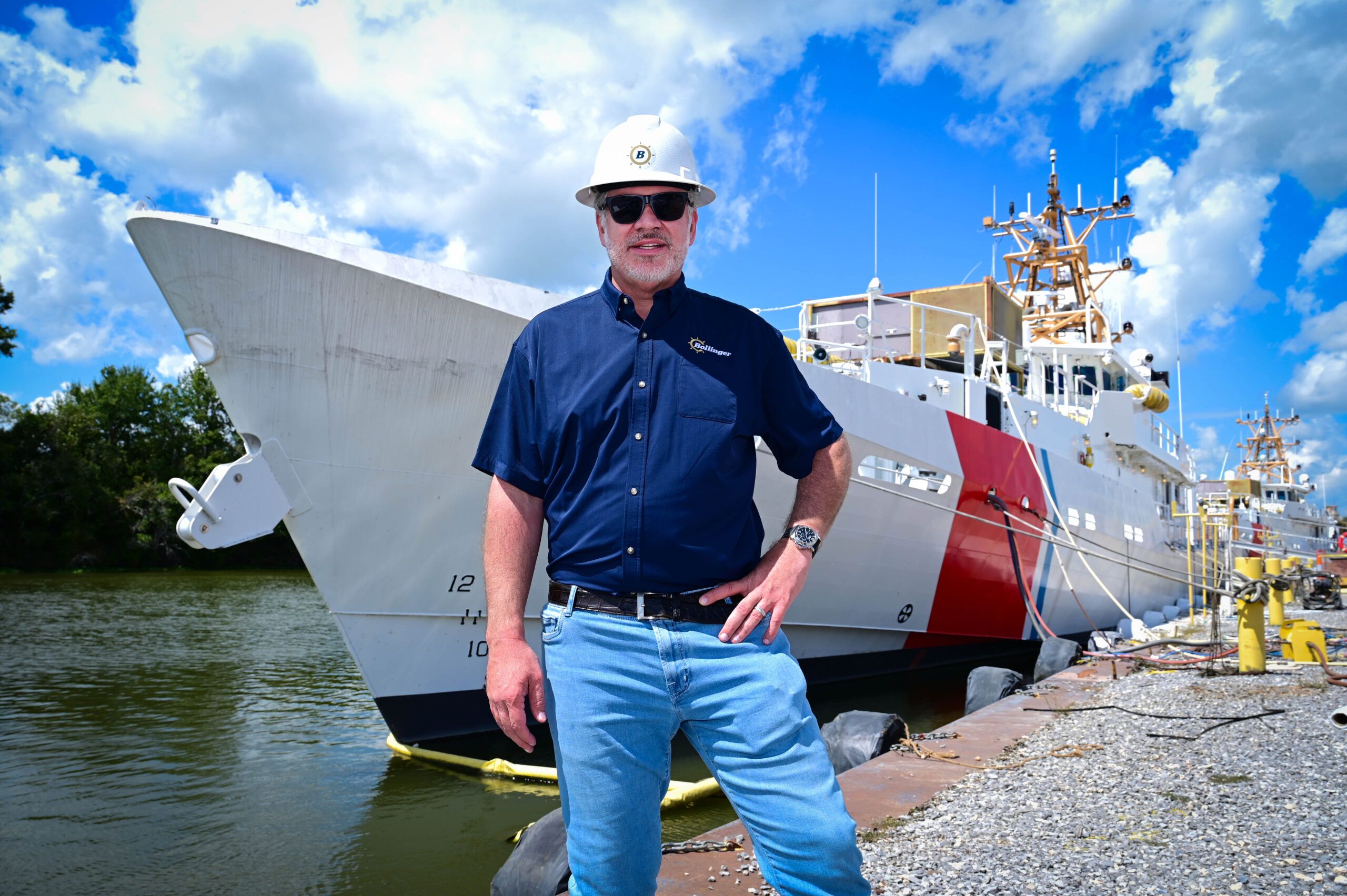
“We haven’t been awarded that yet, but I certainly feel like we’re well positioned to win that program,” says Ben Bordelon, president and CEO of Bollinger. “The administration wants vessels fast and they want them now, so we put a team in place that I feel has the best design, as well as the best shipyard (Rauma) for icebreakers and complex vessels. They have the capacity now, and our combined effort will get vessels delivered quickly while ensuring that much of this program is built here in the U.S.”
Being privately owned helped Bollinger put the deal together quickly. The strategic partnership leverages the trilateral ICE Pact framework between the U.S., Canada and Finland to rapidly grow a modernized U.S. icebreaking fleet, with delivery of the first vessel within 36 months of award.
So far, Bollinger has gone through the vetting process, created a proposal and submitted the plan to the White House.
“I spent some time in Finland, along with some of my management team, and got a chance to get my boots on the ground and meet the CEO of the Rauma facility,” Bordelon says.

Diversification has been critical to Bollinger’s business model, ever since the precipitous decline in the offshore oil and gas market a decade ago. “I consider Bollinger a three-legged stool of a business where we have commercial work, government work and then repair,” Bordelon says.
“I feel like we have a great structure and a great footprint of facilities. We have 80 years that we’re going to be celebrating next year, but we’re also very forward leaning and progressive. We need to keep growing, pushing and developing our facilities, not only from a footprint, structure and technology standpoint, but our workforce as well.”
Domestic Work with Foreign Ties
Some companies stick to domestic work but nonetheless find themselves interacting with international clients. In its capacity as one of the largest industrial contractors in the region, Performance Contractors of Baton Rouge frequently works with overseas-headquartered owners and engineers.
At times, they’ll send managers overseas to assist engineering firms with preliminary designs and “constructability” issues on large mega projects. When that happens, key members of the Performance team might work for up to a year in a European or Asian office.
“It’s usually for the client’s convenience,” says Lee Jenkins, senior vice president of Performance. “They prefer to have us come to them, and we’re happy to do it. When we do that, we’re saddled with them 8 to 12 hours a day for months at a time. It’s a totally dedicated effort, so being together in the same office and in the same time zone has the potential to impact the project in a positive way.”
It also helps build relationships, which can reap benefits during construction.
But even when working on U.S.-based jobsites, local contractors must often contend with incompatible international policies.
“You have to deal with what I would consider to be an international business model … a cultural model that is typically seen overseas that we don’t see quite as often in the U.S., in terms of how projects are executed,” Jenkins adds.

Foreign owners typically prefer a unit price contract—where payment is based on the quantity of work performed at a predetermined price for each unit of work or material—“and that has not proven to be a successful strategy here. That’s not something that U.S. contractors are going to be too interested in.”
Recent hikes in international tariffs have added another wrinkle, particularly in the procurement of materials. Some owners prefer that certain equipment or materials be purchased internationally, but that might not be cost feasible in today’s market.
Jenkins points to differing management styles and contract compliance expectations as additional sticking points.
“From a quality assurance and control perspective, the reporting expectations could vary,” he adds. “Not to say that they’re better or worse, but language barriers, management styles, cultures in the workplace … all these things can definitely have an impact.”