The network of businesses that owe their origins, successes and, at times, demises to Louisiana’s upstream, midstream and downstream oil and gas market is vast.
For generations, an energy workforce numbering in the hundreds of thousands has risen before the sun to travel to a destination that is one, two or multiple parishes away to earn a living.
Nevertheless, it will always be an unpredictable and at times heartbreaking industry in which to work. The current relaxed regulatory environment notwithstanding, the economics of oil and gas—aka supply and demand—will always be the primary driver.
Louisiana has done a decent job since the oil bust of the early 1980s to separate itself from the rollercoaster effects of the unpredictable market. The state has undergone a transformation since the heady days of oil and gas in the early 1980s, when in FY1982 mineral revenues comprised a whopping 42% share of its overall budget. By FY2024, it comprised just 5.9%.
“It was because of the oil bust that we doubled the corporate franchise tax, then began to bring on gaming revenues in the 1990s. We basically changed our tax structure,” says Greg Albrecht, a former Legislative fiscal officer who continues to develop the state’s revenue forecast.
How a ‘small store in the middle of nowhere’ has ties to the energy industry
that take it far behind the southwest Louisiana community it calls home.
As a result, fluctuations in oil prices don’t have nearly the same impact on state finances as they did 40-plus years ago. “Oil and gas revenues are clearly important,” Albrecht says, “but not nearly as impactful to the budget when you get big fluctuations in price.”
That has become starkly apparent in recent months. In FY2024, the state realized an actual mineral revenue collection of nearly $1 billion, consisting of $828 million in severance taxes and $132 million in royalties. Then, in FY2025, the number dropped precipitously to $445 million, largely due to a significant drop in oil prices.
 The revenue drop won’t cripple the state budget, though, as it might have done in the past. That’s fortunate, since Albrecht’s most recent state forecast, released in May (the final numbers won’t be available until October), predicts the current oil price of $65 a barrel will likely be sustained through FY2026 “and could actually be lower depending upon the source,” he says.
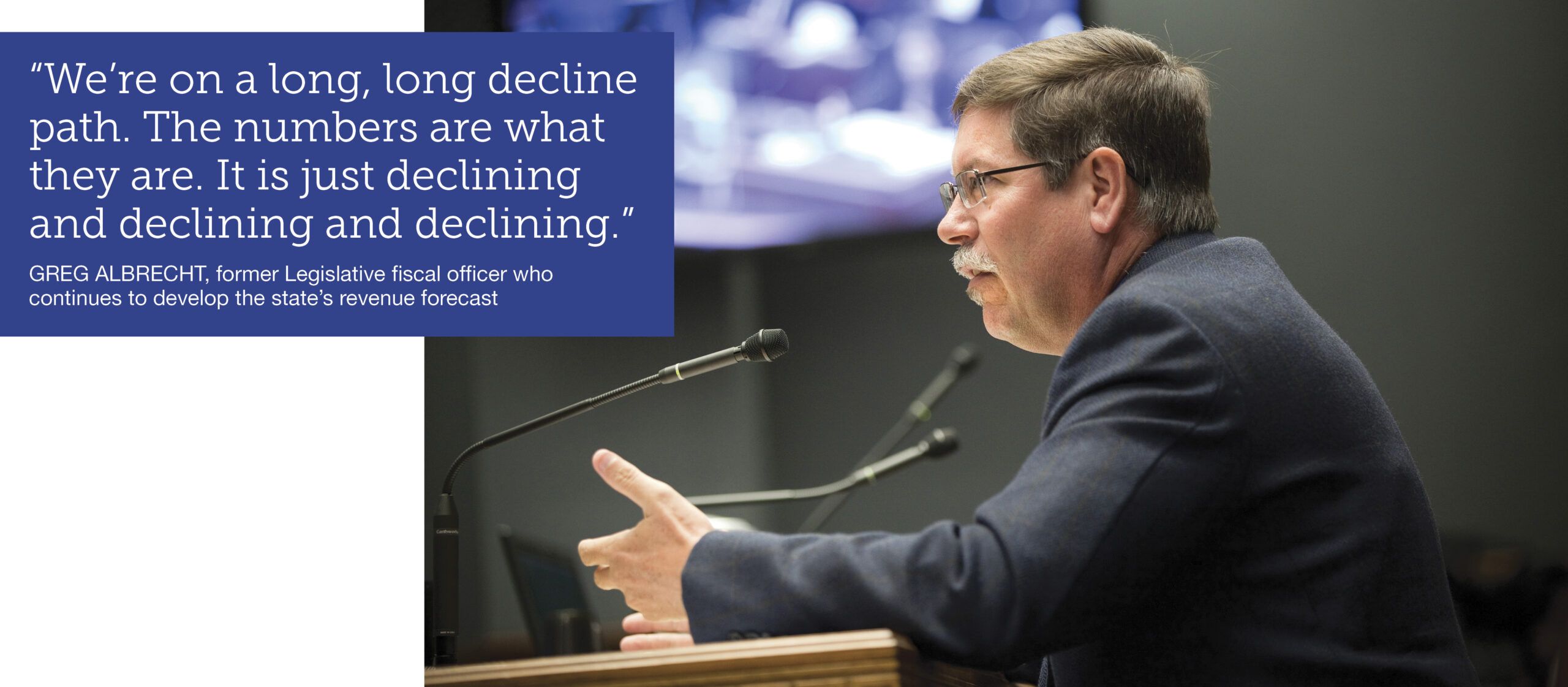
Upstream production has also been trending downward for years, although its short-term impact isn’t as severe as a drop in prices. “We’re on a long, long decline path,” he says. “The numbers are what they are. It is just declining and declining and declining. The nonhorizontal natural gas production is doing the same thing.”
For his purposes, though, Albrecht has frozen projected production volumes at a certain minimum level in his long-term forecast models.
Offshore Oil & Natural Gas Save the Day
Energy diversification will be a sustaining force in the near and long term. Even as onshore oil production steadily declines, offshore oil and inshore natural gas (horizontal extraction) are surging; increased investments in LNG, midstream and downstream facilities will play significant roles.
Improving technologies are making much of it possible.
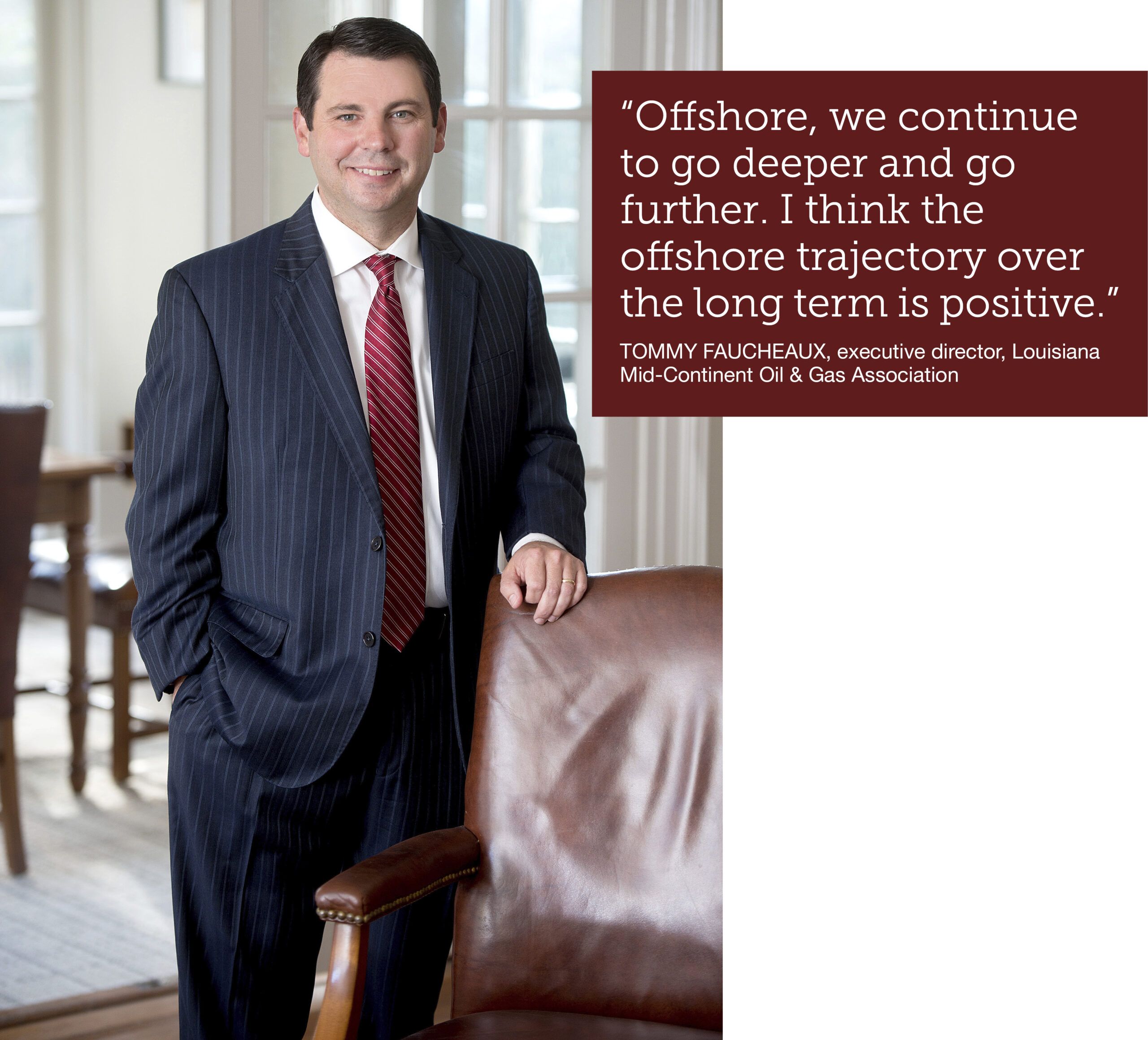
“Offshore, we continue to go deeper and go further,” says Tommy Faucheux, executive director of the Louisiana Mid-Continent Oil & Gas Association. “And now that we’re clearly headed back to a place of predictable federal offshore leasing, I think the offshore trajectory over the long term is positive.”
Of course, economic factors will play a bigger role in any future production decisions, with international demand being a significant factor in the coming decades. Faucheux is particularly excited about the growth of the LNG market, and natural gas in general, as it will likely be the “go to” low-carbon fuel in the near term.
“That is going to be where Louisiana will benefit,” he says. “To have more production in the Hayesville Shale, as well as capacity increases and exports along the coast … that will clearly mean good things for Louisiana.”
In LMOGA’s recent 2025 Economic Impact Study, economist Stephen Barnes found that Louisiana’s energy industry—upstream, midstream and downstream—contributes directly and indirectly to some 25% of the state’s economy.
Barnes, director of the Kathleen Babineaux Blanco Public Policy Center in Lafayette, asserts that industry accounts for 15% of total state employment, 19% of total earnings and up to 31.3% in local property taxes.
Unlike neighboring Texas, Louisiana’s oil and gas companies don’t benefit from concentrated metro areas such as Houston or Dallas; instead, they’re more regionally focused, Faucheux says.
The LMOGA study identified four energy “super regions” where more than 90% of the industry’s economic impact in Louisiana is concentrated—the River Region (Baton Rouge to New Orleans), Bayou Region (Lafayette to Houma), Southwest Louisiana and Northwest Louisiana.
“Few companies in the industrial sector would be successful if their livelihoods depended upon one community or parish,” Faucheux says. “At a minimum, they need this regional collectivity of parishes and communities to support what they’re doing. Then, in turn, the economic impact goes back to those regions.”
That’s perhaps most evident in the River Region, where industry pays more than $600 million in local property taxes—some 17% of the total received.
“That money supports the school systems, the sheriff’s offices, local emergency services, infrastructure etc.,” Faucheux says. “Imagine what kind of hole that would leave in the community if industry wasn’t there.
“In the Bayou Region, its $119 million in property taxes; then there’s sales taxes too. Those are very reliable, predictable revenue streams for local government.”
That translates into a better quality of life, says Faucheux, a former Dow employ who lives in St. Charles Parish. “It really does lift everything,” he adds. “I see how multiple generations of families are getting stronger because of the opportunities that come from industry. Both my grandfathers were in industry, and my dad retired from industry. I’m the first one to go to college. Hopefully, my kids will get some of the same benefits.”
Supply & Demand Edges Out Regulatory Policy
For inshore Louisiana, at least, it has been a tale of two fossil fuels: Natural gas production has gone up while oil production has gone down.
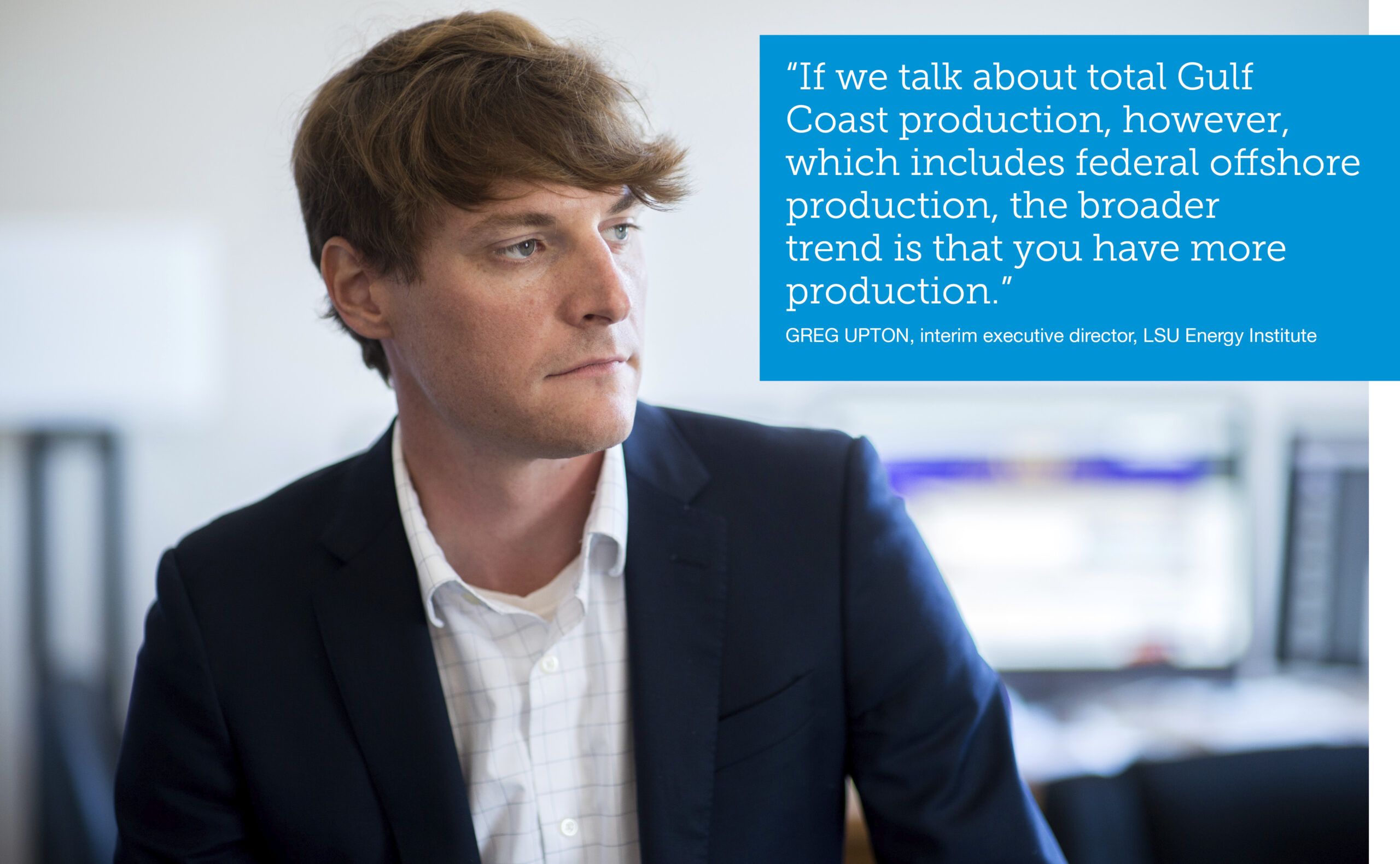
“And these are long-term trends,” says Greg Upton, executive director of LSU’s Center for Energy Studies and interim director of the LSU Energy Institute. “Oil production in state lands and waters—which are subject to the state severance tax—have been going down due to this decline curve.
“If we talk about total Gulf Coast production, however, which includes federal offshore production, the broader trend is that you have more production.”
But while technology has played an undeniably beneficial role, it’s had an inverse effect on employment.
That’s been somewhat surprising, Upton says. “Just looking at upstream oil and gas, the employment numbers are actually coming in lower than we forecasted them to do,” he adds. “We’ve seen downward revisions in the employment numbers over a year ago.”
Technology, he says, has made it possible to produce more hydrocarbons with fewer workers. “The longer-term trend is for production to increase within the Gulf Coast region as well as the U.S.,” Upton says, “but you need fewer workers to produce that same amount of output. So we’re just not seeing this uptick in employment in those sectors.
“Owners have learned how to perform more detailed geological assessments with 3D seismic capabilities, then drill horizontally into these formations with hydraulic fracturing. Historically, they wouldn’t have been able to efficiently do that.”
That’s led to rapid increases in oil and gas production as companies learn how to extract more for less cost.
“We’re in a longer-term trend right now of efficiency improvements,” he adds. “When offshore companies started learning how to go deeper and deeper, that was a breakthrough technology with significant long-term impacts.”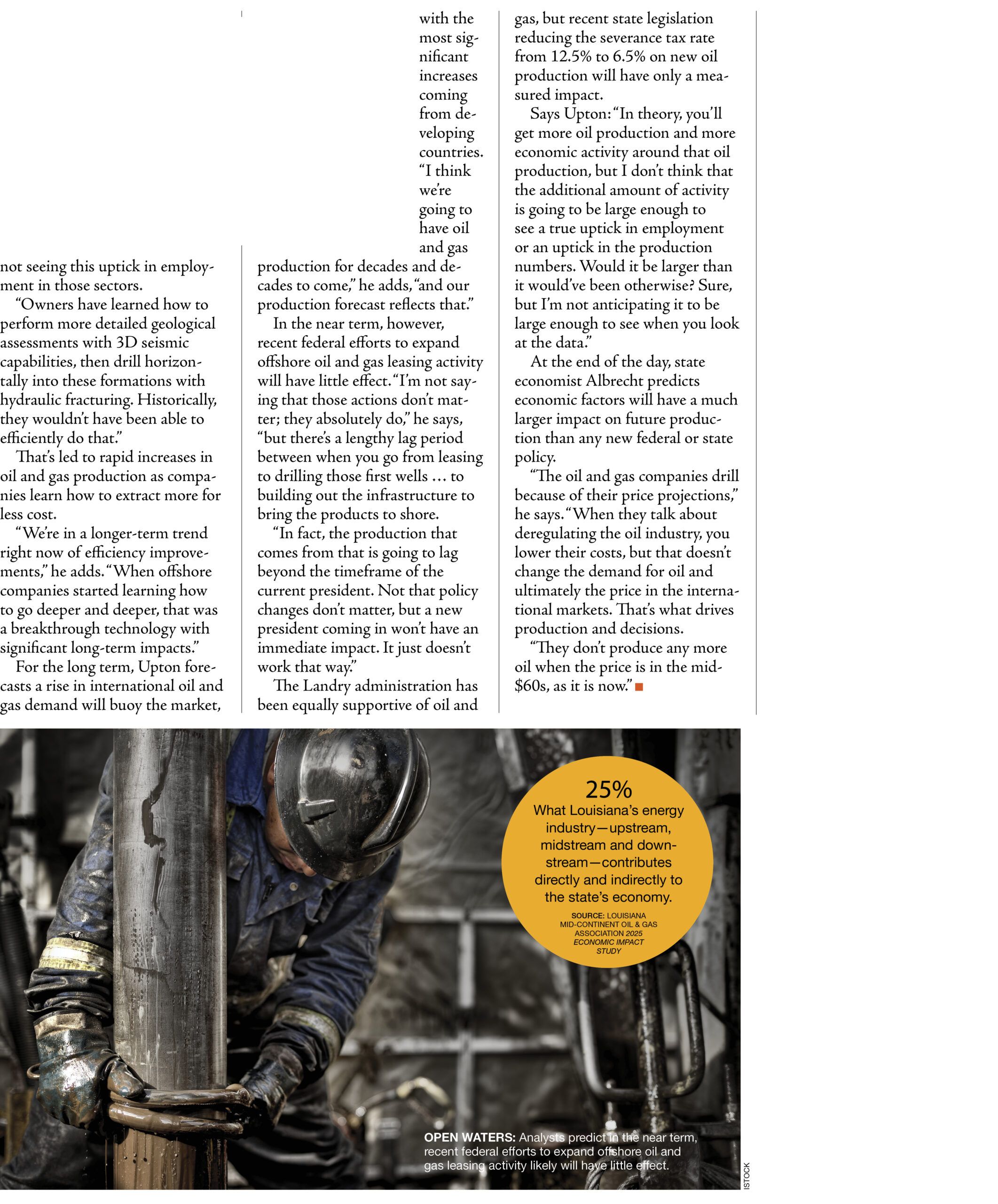
For the long term, Upton forecasts a rise in international oil and gas demand will buoy the market, with the most significant increases coming from developing countries. “I think we’re going to have oil and gas production for decades and decades to come,” he adds, “and our production forecast reflects that.”
In the near term, however, recent federal efforts to expand offshore oil and gas leasing activity will have little effect. “I’m not saying that those actions don’t matter; they absolutely do,” he says, “but there’s a lengthy lag period between when you go from leasing to drilling those first wells … to building out the infrastructure to bring the products to shore.
“In fact, the production that comes from that is going to lag beyond the timeframe of the current president. Not that policy changes don’t matter, but a new president coming in won’t have an immediate impact. It just doesn’t work that way.”
The Landry administration has been equally supportive of oil and gas, but recent state legislation reducing the severance tax rate from 12.5% to 6.5% on new oil production will have only a measured impact.
Says Upton: “In theory, you’ll get more oil production and more economic activity around that oil production, but I don’t think that the additional amount of activity is going to be large enough to see a true uptick in employment or an uptick in the production numbers. Would it be larger than it would’ve been otherwise? Sure, but I’m not anticipating it to be large enough to see when you look at the data.”
At the end of the day, state economist Albrecht predicts economic factors will have a much larger impact on future production than any new federal or state policy.
“The oil and gas companies drill because of their price projections,” he says. “When they talk about deregulating the oil industry, you lower their costs, but that doesn’t change the demand for oil and ultimately the price in the international markets. That’s what drives production and decisions.
“They don’t produce any more oil when the price is in the mid-$60s, as it is now.”